|
| On the lookout for Gila monsters in Saguaro National Park. |
They say "a change is as good as a rest" and a rather dramatic
change for a couple of paddlers might be to leave the ocean and the sea kayak cockpits behind and get "freeze / dried"...and what better place than Saguaro National Park, in the Sonoran Desert of southern Arizona. Thanks to a very kind and generous invitation from a couple of our special folks here, offering to share their winter "base camp" in AZ for a few days, a definite adventure beckoned.
 |
| Teddy-bear cholla cactus. |
The Sonoran Desert...Africanized killer bees, Gila monsters, rattlesnakes, massive cacti. OK, so the Gila "monsters" are only about a foot long. But they are, from what we understand,
one of only two venomous lizards in the whole world. We learned that they "
chew the venom" into the bite! Ouch, that has to be nasty.
The killer bees also have an interesting
modus operandi, if aggravated. The sign at the Red Hills Visitor Center warned that if the bees elect to swarm you, the best strategy is to cover your face...and
run away from them. The information assured us that after half a mile or so (about a
kilometre in our "metric" part of the world), they would tire of the chase and go home. Sure, trail running is usually fun - but here? Moving quickly
any distance on these rocky and often steep and precipitous trails, and in the heat of the day, I don't think so. The rattlesnakes? Surely they would give some warning? The cacti? Simply awesome.
 |
| Prickly pear cactus. |
We chose the 10-mile Hugh Norris Trail but our "Canadian minds" think in terms of kilometres and we sometimes forget that "miles" are
significantly longer. The completion of this trail requires 5-7 hours - and
plenty of water.
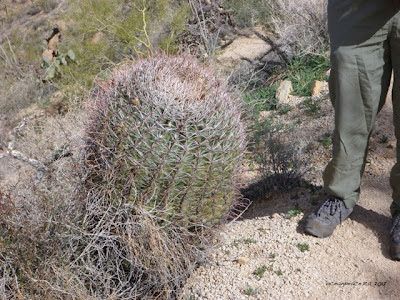 |
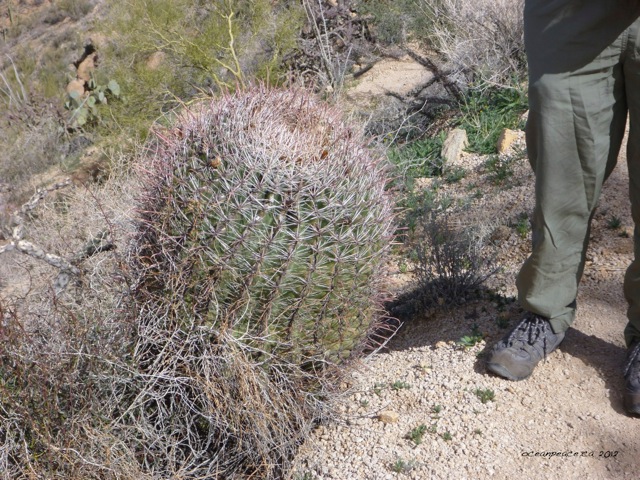
| Golden barrel cactus. |
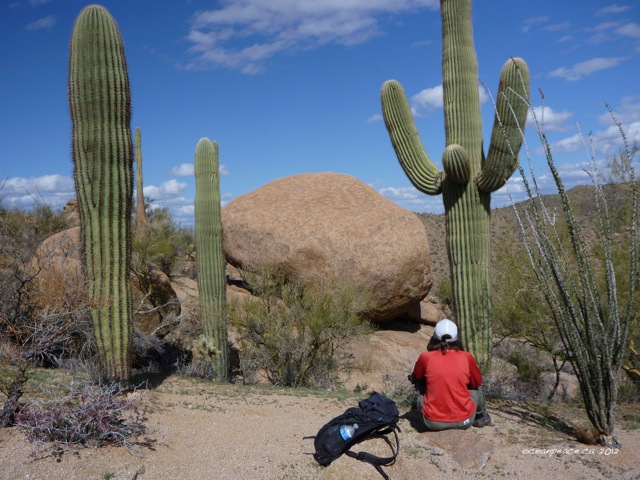
It's a harsh and unforgiving land but cactus, shrubs, and desert trees, in countless forms, flourish. The Saguaro cactus, is recognized far and wide as a symbol of the American Southwest - it's clear why they are known as the "Monarch of the Sonoran Desert". They can be massive and live to be 200 years old.
 |
| Never-ending need keep hydrated in the desert - both humans and cacti! |
Desert travellers stop often to drink - both water and to "drink in" the stunning landscape. So used to the coastal climate, it was hard for us to imagine how folks survive the heat and the dryness. It was just the middle of February, but the relentless sun and heat sapped our energy.
 |
| Stunning beauty. |
As if to deny the desert a "win" - colourful, delicate (but certainly hardy) desert flowers bloomed in dramatic colours.
 |
| Desert flowers - symbolic of "where there's life, there's hope". |
The trail wound around the hills, gaining and losing elevation continually. We encountered just four or five human beings along the entire trail...
but no Gila monsters...
 |
| The trail felt as if it would go on forever...it did. |
or killer bees...
 |
| Ouch - natural defence capabilities of cactus! |
or rattlesnakes.
An encounter with any of these desert inhabitants
might have made a cool story - but we're OK with the way it went.
 |
Saguaro cactus: From a seed the size of a pinhead
to a giant, 50 feet tall and up to 8 tons - in 200 years! |
There were, however, reminders of both life and death and the struggle to survive that all creatures, great and small, share.
 |
| A "skeleton" (the woody ribs under the spongy flesh) of a Saguaro cactus. |
Time in the desert reminded us that all living things attempt to grow and flourish, expressing their own unique identity and place in creation. We humans, perhaps, have the unique ability to also
contemplate,
reflect on, and then
share with one another our experiences in wide and wondrous ways, such as in a simple "blog" as this. The connections we make create a sense of community.
 |
Sometimes you just have to pause, lay down your heavy pack,
breathe deeply and slowly...and take in the wonders of the natural world. |
When we had gone as far as we felt we could safely go, before losing the sun and inviting the freezing night-time temperatures that would surely provide us with a "freeze / dry" experience, we briefly caught our breath...and retraced our steps.
Such a self-propelled, outdoor experience is deeply enriching...much like time on the ocean in a narrow kayak.
So, is desert hiking antithetical to sea kayaking? No, not really. I think, in a rather strange way, they are very close "cousins". :)
Duncan.
Next: A quick overnight sortie into the high, cold, icy, and snowy country of Flagstaff and the Grand Canyon.