If time is really a river
and upstream's where he needed to be...
- from a Colin Raye song, "The time machine".
 |
The Nether Largie standing stones...
evidence of human hopes and dreams of 4000 years ago? |
Just sitting with the laptop in a hotel lounge / bar, a couple of blocks from the self-catering flat where we're staying in downtown Oban. Sharing the table with us are a couple of good early-morning, strong coffees and two fruit scones. In the background, Bob Dylan's, "Like a rolling stone" has just transitioned into a beautiful Bob Marley piece. The relaxed atmosphere is perfect for reviewing the past few days of hill walking in the wind and rain - and the occasional hail.
Kilmartin Glen, to the south of Oban, is a haunting landscape, arguably one of the richest in prehistoric artifacts as any place in Europe. In the quiet, green pastoral fields lie abundant evidence of those who traveled the same course around the sun as we all do this very day. Somehow, these Neolithic and Bronze Age people still "live and breathe" in the cairns, the stone
cists or coffins, and the standing stones that they left behind over 4000 years ago.
How these ancient monuments have survived so long is unimaginable. Not much else does. What they truly signify may never be known. To simply stand near them is to be transported "upstream"...to a distant past.
 |
| Joan (left) gives scale to these magnificent standing stones. |
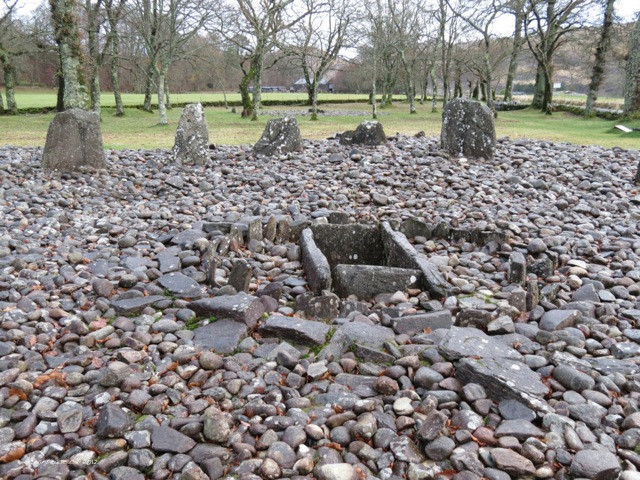
The two stone circles, at Temple Wood, appear to have been a "work in progress" between 3000 and 1200 BC. Any project that spans 1800 years puts in perspective our modern craving for "right now".
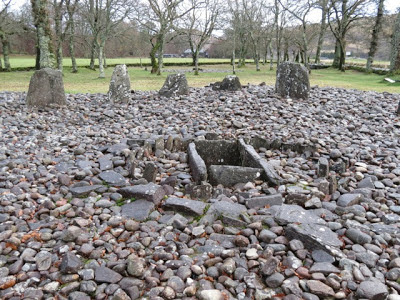 |
| The 12m stone circle, with buriel cist at Temple Wood. |
Five cairns, piles of what appear to be smooth river rock, form a linear cemetery over a distance of eight kilometres.
 |
The most northerly of a series of Bronze Age
chambered cairns, the Kilmartin Glebe Cairn. |
This is a lonely and deserted place in mid-November. The wind was cold and the weather constantly changing with a few moments of blue sky and sunshine, dramatically chased away by dark clouds squalls and icy pellets falling from the sky. It was a wonderful time to be in Kilmartin Glen.
And we weren't alone...
Shaggy "sentinels" of the glen keep watch.
 |
Here's lookin' at you! "Ram tough"? This full time resident
of the Kilmartin Glen appeared pretty relaxed to us. |
No walk around Kilmartin Glen is complete without climbing to the top of nearby
Dunadd, the rough and rocky crag that stands above the surrounding fields and bogs and the location of an ancient fortress. In 500 AD, Dunadd was the capital of the Scottish Kingdom of
Dalraida.
 |
Atop the Dunadd Hillfort Crag...
the view alone is worth the slippery scramble in a hail storm.
The Summit Slab is in lower right. |
At the top of Dunadd is the "Summit Slab"...and the carved stone footprint that is said to have been part of royal ritual for untold centuries.
 |
| A closer look at the Summit Slab, with carved footprint... |
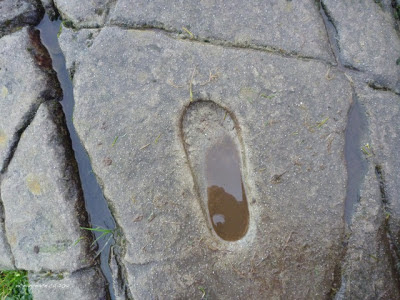 |
| ...and still closer. |
 |
I had to know...
the sense of mystery and awe will last forever. |
While at Dunadd, the ceiling and visibility vanished as a squall passed through. In wet-weather gear, the driving rain simply served to enhance the experience...and the sense of mystery.
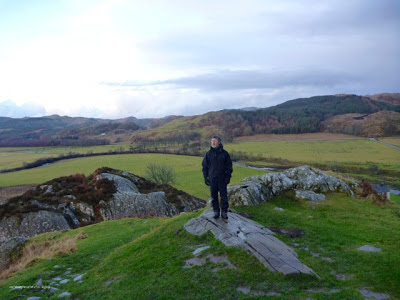 |
| Humbled by the thought of those who had stood in this very place. |
And then, suddenly, as quickly as rain and wind had come, the skies cleared and the last rays of the setting sun illuminated the rust-coloured hills beyond the fortress crag.
 |
Following the storm...
the sun breaks out over Crinan Moss and surrounding hills. |
It was magical.
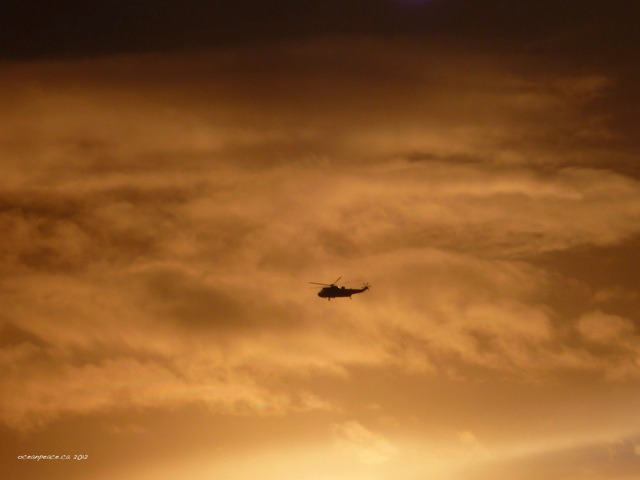
A familiar "thump thump thump thump", however, eventually broke the spell...but although such experiences are "transient", they remain, in all the ways that matter, forever.

|
From the top of Dunadd...it's back to the present.
Could those ancient people ever have imagined such a sight before the setting sun? |
Every so often, it's probably a good thing to "paddle" back in time, to touch and taste, albeit in some infinitely small way, the world as it was..."upstream". It puts so much of our living in perspective. It's a reminder that we need to resist living as if it's
"all about us" - just us. These days, we often seem to live that way, believing that the universe revolves around our own personal lives, having convinced ourselves that it is our
own struggles and difficulties are all that matter.
I think about those that lived in this very place, 4000 years ago. They had hopes and dreams and they struggled to survive in a world unimaginable to most of us. They shared triumphs as well as tragedy. They too probably sought shelter from the storms...but they had fewer places to hide away. I have a sense that it was their cherishing of "community", their shared lives, and their dependence on one another that was key to their longevity over thousands of years. It was probably all about the
community. It's "community" that
we need to nurture - positive and affirming engagement beyond tribe or clan, language and nationality, faith and politics - and in ways that benefit and enrich us
all.
We also need to simplify our lives and take pleasure in the beauty of nature and all that she offers - on both the calmest and the stormiest of days.
Somehow, this hotel lounge / bar now feels so far from where we need to be. Comfortable? I suppose. But only for for the purpose of brief respite and yes, internet connection.
There are so many more lessons to be learned in this wildly beautiful place and in the wind and the rain -
outside. :)
Duncan.